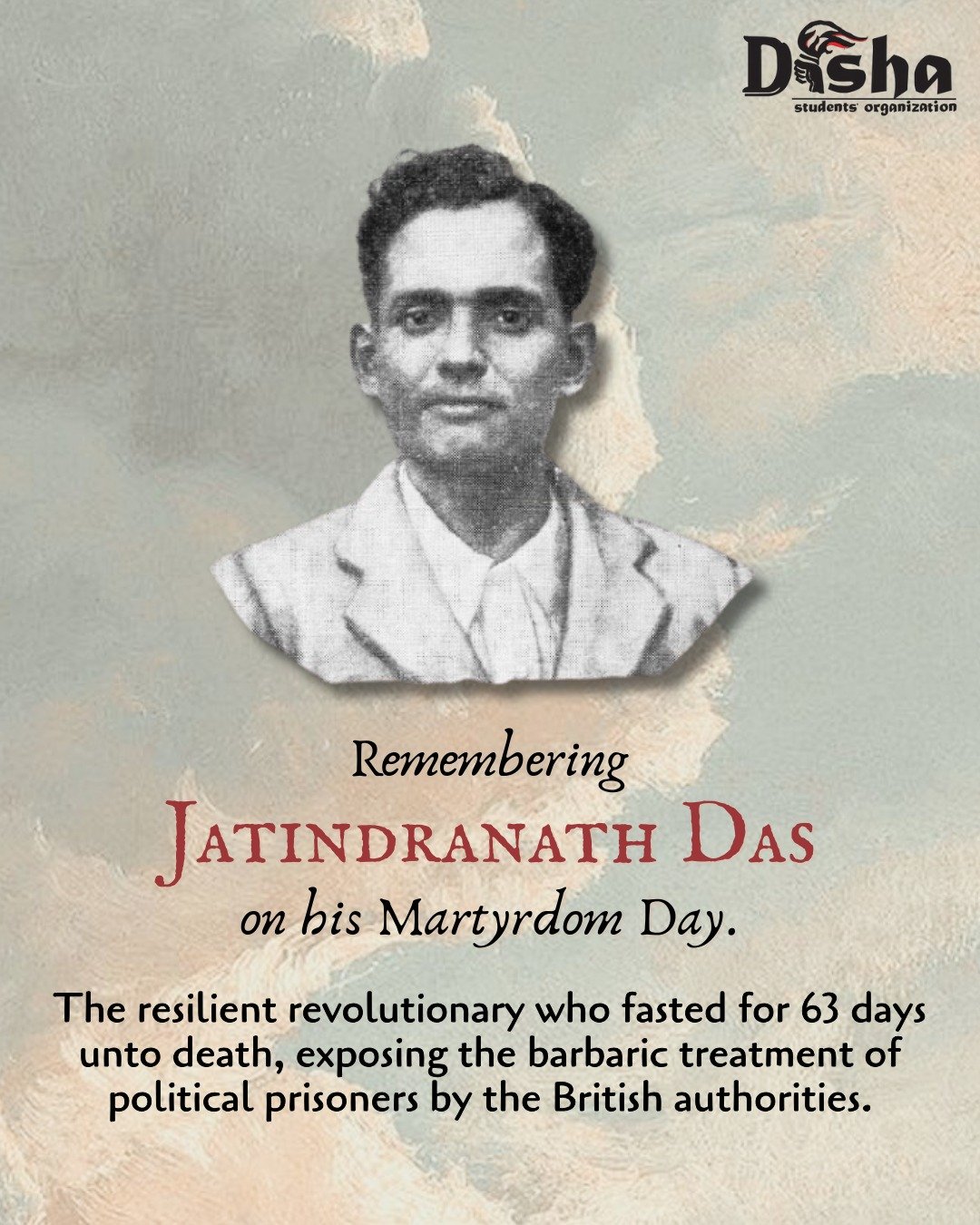
Remembering Jatindranath Das on his Martyrdom Day!
The resilient revolutionary who fasted for 63 days unto death, exposing the barbaric treatment of political prisoners by the British authorities.
Born on 27th October 1904 in Calcutta, Jatindranath Das was inspired by the emerging revolutionary movements in Bengal and drawn to the quest for Indian Independence from an early age. In 1921, at the tender age of 17, Das joined the Non-Cooperation Movement led by Gandhi. Soon after, he joined Anushilan Samiti, a revolutionary organisation committed to armed resistance against British colonialism. There he participated in activities aimed at destabilising British governance and learnt the skills of guerilla warfare.
While pursuing BA at Vidyasagar College in Calcutta, in November 1925, he was arrested for political activities and was jailed at the Mymensingh Central Jail, where he resorted to hunger strike to protest against the ill-treatment meted out to political prisoners. After fasting for 20 days, the Jail Superintendent apologised and he ended the fast.
From the end of 1928, Das came into contact with Bhagat Singh, Chandrashekhar Azad and other revolutionaries of the Hindustan Socialist Republican Association (HSRA). He worked with them and taught several of them guerrilla warfare. When Bhagat Singh and Batukeshwar Dutt were arrested after the assembly bombing, Jatin Das along with other revolutionaries were also arrested as part of the Lahore Conspiracy case.
With the exception of a few Congress leaders, Indian political prisoners were given inhuman treatment in jails. Not only were they not provided with facilities of washing, bathing, reading, writing, but also forced to do hard labour and were treated with contempt and humiliated by the jail authorities. Bhagat Singh and Batukeshwar Dutt, arrested together after the Assembly bombing scare, decided to start a hunger strike for the rights of political prisoners and after the other political prisoners found out about it, they also joined.
Das knew the dangers from past experience, but willingly joined the strike. The police tried to forcefully break their fast. Das and others resisted fiercely. Doctors tried to force-feed Jatin Das through tubes, but he resisted and the tube forced milk into his lungs instead. Almost a litre of milk in his lungs meant his condition deteriorated severely. Admitted to a hospital in a weak condition, Das still found the strength to resist, denying any oral or nasal tubes or intravenous injections to give him treatment. The revolutionaries had made a pact to deny all food and treatment and fast unto death if their demands were not met. The jail authorities even tried to forcibly remove Jatindranath Das from the jail, but he wouldn’t flinch. His words stopped after a few days, then his limbs stopped moving and slowly his eyes closed shut but he still moved his head to answer ‘yes’ or ‘no’ to questions from his comrades. On the 13th of September 1929, Jatindranath Das was on his deathbed when a doctor tried to give him an injection thinking he would not notice. Das opened his eyes, swiped his hand and shouted ‘No!’ even in his last moments. And he passed away on the same day.
The news of his demise spread like wildfire in Lahore and around the country. Thousands gathered outside the jail. His body was taken to Kolkata by train. In every station that the train stopped on the way, thousands came to pay respects, with lakhs of people gathering in Calcutta. The sacrifices of revolutionaries like Jatindranath Das inspired lakhs to join the freedom struggle and dream of a better society, a truly equal and just one.
It is this insurmountable resistance, will and sacrifice of Shaheed Jatindra Nath Das that should inspire the students and youth of today as we face the challenges of our current society as well. It is to be noted that the revolutionaries of our independence movement later reflected on their methods and recognised that freedom cannot be brought about through individual acts of violence, but needed mass mobilisation to bring down the entire colonial system. This is precisely our task today.
Independence from the British has not changed much in the lives of the common toiling masses. Seventy years on, we face deteriorating conditions not just in our institutions but in our civic, political and social spaces. With the rise of communal fascist rule, there is a rapid increase in the attack on democratic rights of students, on the right to education and employment opportunities. We face uncertain futures with privatisation, contractualisation, crumbling infrastructure and false promises.
Taking inspiration from the conviction and strength of our martyrs like Das and his companions who resisted communalism and dreamed of a society free of exploitation and oppression of man by man, students of today should realise that the current capitalist system is destroying our education system and our hope for equality in the future. It is only our unity based on our concrete demands that can build the movement for a revolutionary transformation of society, and only this would be the fulfilment of our martyrs’ visions.
– Disha Students’ Organization
– Disha Students’ Organization